Logarithmic Learning Tools as Antidotes to Exponential Growth of Information
Mathias Torp, Innovation Engineer
Summary
Logarithmic learning is an innovative approach tailored for the modern era's information explosion. Traditional linear learning methods, focused on exhaustive, detail-oriented models, struggle to keep pace with today's rapid data growth. Logarithmic learning, however, recalibrates our understanding and intuition to align with new developments, efficiently bridging the gap created by the exponential increase in information.
This approach is based on the principle that not all new information significantly alters our understanding. It focuses on strategically adjusting our mental models where necessary, filtering out redundant data. By applying logarithmic principles to learning, we can transform the exponential growth of information into a manageable, linear increase in learning requirements. This means that as the volume of available information skyrockets, the amount of new information we need to process and understand can remain constant.
AI and technology play a crucial role in this transformation. They offer personalized learning paths and focus on recalibrating and extending a learner's intuition. This shift to intuition-based learning is essential for navigating an ever-evolving landscape of information, allowing us to make informed decisions based on relevant, current knowledge.
In educational settings, this means curricula can dynamically adapt to individual students, enhancing both the efficiency and effectiveness of education. For professionals, logarithmic learning tools provide customized training and enable organizations to proactively equip their workforce for future changes. This approach also emphasizes the importance of understanding and managing information entropy, enhancing students' confidence, and enabling them to engage with complex material more effectively.
In conclusion, logarithmic learning is a vital evolution in our approach to education and professional development. It not only helps us manage the deluge of information but also ensures that our learning and knowledge-sharing methods are efficient, effective, and sustainable in the face of the Information Age's challenges. By adopting logarithmic learning, we prepare ourselves to thrive in a world where change is the only constant.
Introduction
In the modern era, we are experiencing an unprecedented surge in the volume of information available. From scientific research to daily news, the amount of new data generated each day is growing at an exponential rate. This information explosion presents a unique challenge: how can we, as humans with relatively fixed cognitive capacities, keep pace with this relentless tide of knowledge?
Enter the concept of logarithmic learning tools. These tools are designed not just to compress information but to recalibrate our understanding and intuition in line with new developments. They represent a shift from quantity-focused learning to quality-focused, intuition-driven understanding.
The Challenge of Linear Learning
Traditional learning methods, largely linear in nature, are becoming increasingly inadequate in the face of this information deluge. Reading comprehensive texts, attending lengthy lectures, or even going through AI-generated summaries – all these methods still operate within the paradigm of linear information processing. They attempt to compress the volume of information but do not fundamentally alter the rate at which we, as learners, must adapt to new knowledge.
Even with advancements in AI that provide summaries of complex data, we encounter a critical challenge: the sheer number of summaries we need to keep up with is still increasing. Imagine a scenario where every day brings a flood of new research papers. Even if AI compresses these into concise summaries, the total number of summaries to read grows daily. Consequently, the learning requirement – the time and cognitive effort needed to stay informed – is still expanding exponentially. This trend underscores the inadequacy of linear learning tools in an age of information abundance.
However, the future of human roles alongside AI is not in competing with these systems in information retrieval or processing but in focusing on high-level, intuition-focused thinking. As AI and information-retrieval systems become more adept at handling details and incorporating the latest research, the human role will shift towards overseeing, interpreting, and applying this knowledge in creative and contextually appropriate ways.
In this context, intuition calibration emerges as a key method to achieve logarithmic learning. This approach recognizes that not all new information significantly alters our understanding. Much of the new research may align with our existing intuition, rendering it effectively 'noise' in the learning process. True learning happens when new information adds to or corrects our intuition. It's about strategically adjusting our mental models, making significant updates where necessary, while filtering out redundant data.
Logarithmic Learning: Bridging the Exponential Gap
Logarithmic functions, by their very nature, are the inverse of exponential functions. This mathematical relationship offers a powerful insight into redefining our approach to learning. If we apply a logarithmic function to learning – that is, if we design learning tools and methods that recalibrate and update our understanding in a logarithmically efficient manner – we can transform an exponential growth of information into a manageable, linear increase in learning requirements.
This transformation is crucial. It implies that the amount of new information we need to process and understand on a daily basis can remain constant, even as the volume of available information continues to skyrocket. Such an approach is the essence of logarithmic learning: ensuring that our learning scales effectively, even in the face of overwhelming data growth.
Visualizing the Information Growth Challenge
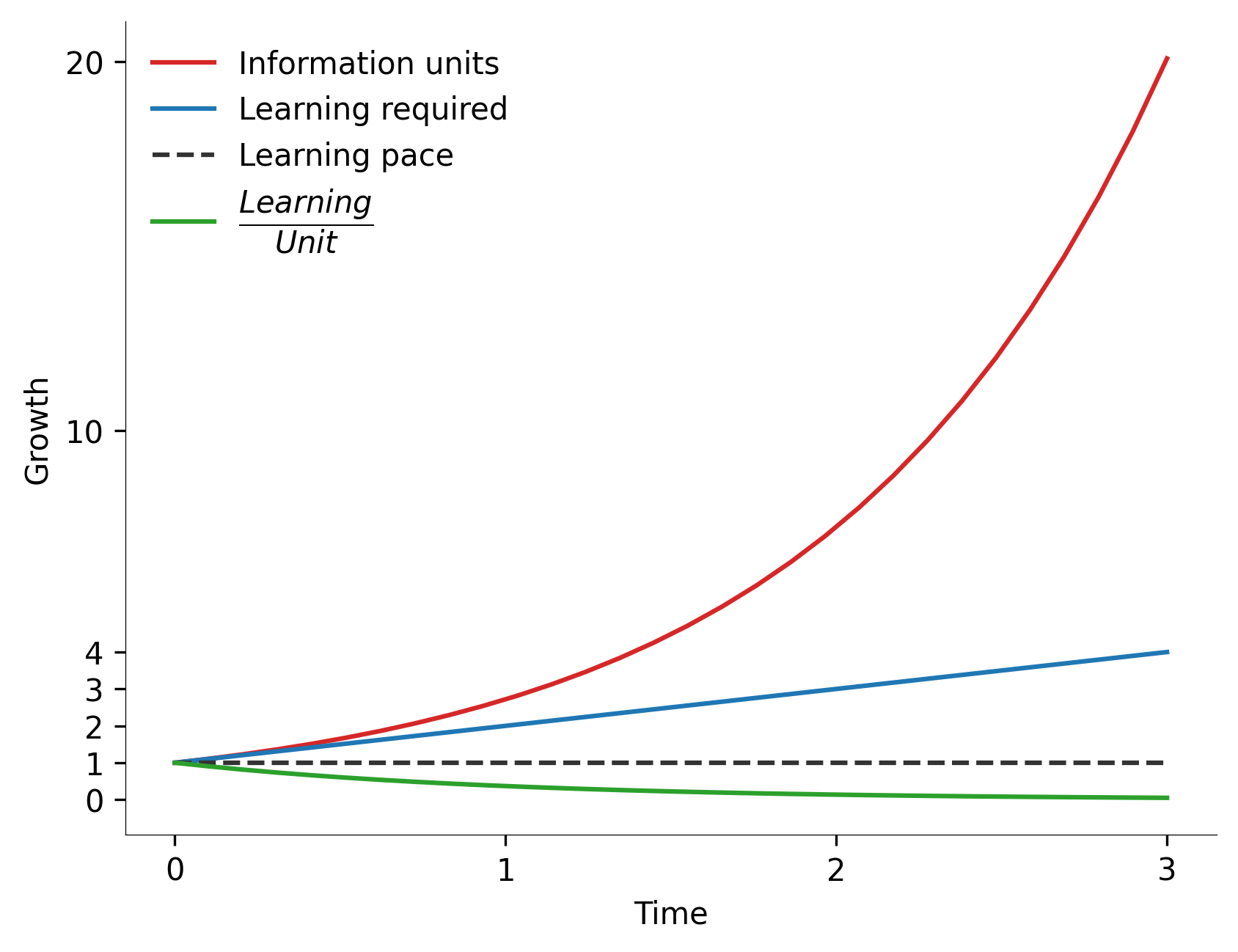
In the midst of the Information Age, the visual depiction of our learning trajectory becomes a powerful tool for understanding the challenges and solutions in managing knowledge acquisition. The graph captures the essence of this journey, illustrating key points about the growth of information against the backdrop of human learning capacity.
The figure presents a striking visual contrast between the rapid expansion of information and the steady pace of human learning. The exponential curve, painted in a stark red, climbs steeply, embodying the relentless increase in data we're faced with daily. In contrast, a horizontal dashed line marks the human capacity for learning, a constant that underscores the limitations of our cognitive processing. Alongside, the blue line mirrors this horizontal trajectory, signifying the effective growth rate of our learning requirements when we utilize logarithmic learning tools. These tools, which the article advocates for, enable us to maintain a consistent, linear growth in our learning demands, counteracting the exponential curve of information. Furthermore, the green line represents the diminishing learning requirements for each new piece of information over time, illustrating the compounding benefit of employing logarithmic learning strategies.
This visual representation embodies the central message of the article, starkly illustrating the disconnect between the exponential growth of information and the linear nature of human learning capacity. It underscores the argument that by adopting logarithmic learning strategies, we can keep our learning requirements within a manageable linear progression. The graph serves not just as a visual aid but as a call to action, urging readers to embrace learning tools that fundamentally align with the principles of information theory and cater to the logarithmic nature of our learning needs.
The image solidifies the article's stance on the importance of adopting strategies that allow us to keep pace with rapid advancements, without becoming overwhelmed by the sheer volume of new information. It stresses that the key to future educational and professional development lies not in consuming data more efficiently, but in enhancing our intuition and understanding, thus preparing us for a future that is intertwined with AI and demands high-level cognitive processing. These tools don't just streamline learning; they ensure it remains relevant and adaptive to an ever-evolving world, providing a framework for seamless integration of new knowledge into our lives and work.
By framing the learning experience within the context of logarithmic learning, we offer a sustainable model for educational growth, ensuring that each individual can continue to thrive in a world where information is abundant and change is the only constant.
Exploring the Logarithmic Learning Approach
In the realm of education and knowledge acquisition, logarithmic learning represents a paradigm shift, fundamentally altering our approach to assimilating new information. This method moves away from the exhaustive, detail-oriented traditional models, steering instead towards a more selective and efficient path. Logarithmic learning is centered around identifying and comprehending the core principles and underlying patterns of new developments. It's not about keeping up with every minutiae but about discerning which updates in our knowledge base will significantly enhance our understanding.
To better grasp this concept, consider the analogy of observing a complex mosaic. In a linear learning approach, one would focus on scrutinizing each individual tile – a method that's thorough but often overwhelming and time-consuming. Logarithmic learning, on the other hand, is like stepping back to appreciate the overall pattern formed by these tiles. This perspective allows for a broader understanding without getting bogged down in the specifics. It's about perceiving the bigger picture, the overarching themes, and the connections between different pieces of information.
Another fitting example is the way GPS systems handle updates. When new roads are constructed, the GPS doesn't undergo a complete overhaul. Instead, it updates only the necessary sections, enhancing the route's efficiency. Similarly, logarithmic learning updates our knowledge where it matters most, without the need for a complete relearning of the subject.
The advantages of this approach are manifold, with efficiency being at the forefront. Logarithmic learning enables individuals to keep pace with the latest developments without the risk of information overload. It aligns more closely with the natural functioning of our brains, which are adept at recognizing patterns and synthesizing core principles. This alignment not only fosters a deeper understanding but also ensures better retention of information.
This method is particularly valuable in rapidly evolving fields, where staying current with the latest information is crucial. By focusing on the most impactful updates, logarithmic learning empowers professionals and learners alike to make informed decisions based on relevant, current knowledge. In essence, it provides a way to navigate the vast sea of information, guiding us towards those insights that truly enhance our understanding and capabilities.
The Role of AI and Technology
The integration of Artificial Intelligence (AI) and technology in the educational landscape heralds a new era of personalized learning. These advancements are not just about making learning more efficient; they fundamentally reshape how knowledge is conveyed and assimilated. AI systems excel in creating customized learning paths, tailoring educational content to the unique needs, preferences, and existing knowledge of each learner.
One of the most transformative aspects of AI in learning is its ability to work with a learner's current intuition, recalibrating and extending it as needed. This approach contrasts sharply with traditional methods like research papers, abstracts, and summaries, which often present information in a one-size-fits-all manner. Traditional methods focus on conveying the content from the producer's perspective, paying little heed to the receiver's existing understanding or learning style. AI flips this approach, emphasizing a receiver-centered communication. It assesses the learner's existing knowledge and intuition, then strategically adjusts or extends current analogies or understanding frameworks, making the new information more relatable and easier to grasp.
This shift has profound implications for both the producers and receivers of information. For researchers and content creators, it means a reduction in the pressure to tailor every piece of new information for diverse audiences. Currently, a significant portion of resources in research and academia is spent on writing and formatting papers to communicate findings, often at the expense of time that could be spent on further research. By focusing on making raw information available, AI can take over the role of tailoring this content to suit individual learners. This division of labor allows researchers to focus on advancing their fields, while AI systems handle the intricacies of personalized content delivery.
The potential impact of AI on education is vast. By centering the learning process around the receiver, AI ensures that the information adapts to the learner, rather than forcing the learner to adapt to the information. This model not only makes learning more effective but also more engaging, as learners encounter material in a format that speaks directly to their existing knowledge and intuition. It opens up a world where education is not just about transferring knowledge, but about fostering a deeper, more intuitive understanding that evolves alongside the learner’s own cognitive and intuitive growth.
As we embrace this new paradigm, we stand on the cusp of a revolution in how we teach, learn, and engage with the ever-expanding universe of knowledge. AI and technology are not just tools in this journey; they are catalysts that have the potential to redefine the very essence of learning and education.
Practical Implications and Future Outlook
The practical implementation of logarithmic learning and AI-driven educational tools presents a transformative opportunity for both educational and professional settings. In schools, universities, and ongoing professional development programs, the shift towards a more intuitive, personalized learning approach could significantly enhance both the efficiency and effectiveness of education.
Implementation in Educational Settings
In the evolving landscape of education, the integration of AI and logarithmic learning tools within schools and universities is setting the stage for a revolutionary shift in how curricula are designed and delivered. This transformation moves beyond the traditional one-size-fits-all approach, ushering in an era of personalized education tailored to the unique learning pace and style of each student.
The adoption of these advanced tools in educational settings means that curricula can dynamically adapt, addressing specific gaps in a student's understanding or delving deeper into areas that pique their interest. This individualized approach not only enhances the learning experience but also ensures that each student can thrive, regardless of their starting point.
Furthermore, AI systems are poised to play a pivotal role in assisting educators. By providing real-time feedback on student performance, these systems can pinpoint areas where students may be struggling and suggest tailored interventions. This capability is not just about improving academic outcomes; it also represents a significant shift in the educational burden. Educators, relieved of the constant pressure to assess and address individual learning gaps, can redirect their focus towards the qualitative aspects of teaching. This shift enables a more in-depth exploration of subjects, fostering a richer educational environment.
The emphasis, however, is not just on acquiring new information. The core of this educational revolution lies in learning to recalibrate intuition. In a world where developments and advancements present an ever-evolving target, the ability to adapt and reorient our understanding becomes crucial. This focus on intuition recalibration represents a fundamental change in learning methodologies. It's about developing an agile mindset, one that is continuously ready to integrate and synthesize new information effectively.
Emphasizing this new approach to learning is crucial for students and professionals alike. It's not merely about staying informed or keeping up with the latest developments; it's about enhancing the ability to weave new information into the existing tapestry of knowledge seamlessly. By nurturing this understanding and ability, the education system prepares learners not just to face the world as it is but to adeptly navigate and shape the world as it evolves. This paradigm shift in learning and teaching heralds a future where the assimilation of knowledge is as dynamic and fluid as the advancements and innovations that drive our world.
Implementation in Professional Settings
In today's professional sphere, characterized by swift and relentless change, the adoption of AI and logarithmic learning tools has transitioned from a luxury to an essential strategy for maintaining relevance and competitive edge. These tools are reshaping the landscape of continuous learning and skill development, making them indispensable in the quest for professional advancement.
In rapidly evolving industries, adaptability is key. AI and logarithmic learning tools give employees a significant edge by providing customized training that is tailored to their existing skill sets and the nuanced demands of their roles. This bespoke approach to professional development ensures that learning is not only relevant but also immediately applicable, thereby boosting both adaptability and efficiency within the workplace.
Furthermore, AI's capability to analyze and predict trends is revolutionizing how organizations prepare for the future. By identifying skill gaps and forecasting upcoming trends, these tools enable companies to proactively equip their workforce for impending changes, keeping the entire organization at the vanguard of industry advancements.
The imperative to stay current with industry developments is underscored by the need for logarithmic learning tools. These tools are crucial in ensuring that professionals do not fall behind, grappling with challenges that have already been addressed. They guarantee that the time invested in learning scales linearly, rather than exponentially with the volume of information, thus conserving valuable time for other essential tasks.
In professional environments, the recalibration of intuition is becoming increasingly critical. With the sheer volume of new developments, it is unfeasible for professionals to remain up-to-date on every nuance. Instead, refining their intuition to align with the latest findings allows them to make more astute decisions and maintain a competitive edge. This learning paradigm prioritizes a deep understanding of trends and patterns over the exhaustive consumption of every new piece of research.
To encapsulate, the integration of AI and logarithmic learning within professional realms is transforming the very nature of career advancement and development. It's not solely about staying abreast of information; it's about fundamentally altering our approach to learning and adaptation. By focusing on intuition and ensuring that learning follows a manageable, linear progression, we empower professionals to navigate and excel in a landscape of constant change, aligning their expertise with the most current and impactful industry developments.
The Future of Learning
As we look toward the horizon of education, the integration of AI and logarithmic learning methods heralds a transformative shift, poised to redefine our educational systems with dynamism, responsiveness, and efficiency. This evolution in education is marked by a significant departure from traditional, static models to ones that are fluid and malleable, adapting to the unique needs, knowledge bases, and learning preferences of individual students.
The future of learning will place an increased emphasis on developing critical thinking and problem-solving skills. As AI assumes the responsibility for more routine learning tasks, like rote memorization and factual recall, learners will have the opportunity to engage more deeply with complex problem-solving and creative thinking, cultivating a deeper understanding and mastery of their subjects.
AI's influence extends to democratizing education, breaking down barriers of geography and socio-economic status to provide high-quality, personalized learning experiences to all. This shift not only levels the educational playing field but also ensures that quality learning is universally accessible.
Against the backdrop of exponential information growth, logarithmic learning emerges as an essential strategy. It equips learners to process the latest developments without being inundated by the vast quantity of information produced every day. This approach allows for the learning process to remain digestible and pertinent, despite the relentless expansion of collective human knowledge.
Perhaps one of the most promising aspects of this new educational paradigm is the potential to reduce the latency between the discovery of new knowledge and its practical application. AI and logarithmic learning tools are set to bridge the gap between innovation and practice, ensuring that learners and professionals can quickly integrate and apply new findings in real-world contexts.
The essence of this future of learning goes beyond simply streamlining the absorption of information; it seeks to transform the very nature of how we think, learn, and interact with knowledge. By adopting these innovative tools and methodologies, we are preparing ourselves for a future that is not only about being well-informed but also about being adaptable, creative, and equipped with the critical thinking skills to navigate and influence an ever-changing world. This new era of learning is destined to cultivate individuals who are not just knowledgeable but also deeply intuitive and capable of driving innovation in their fields.
Information Theory and Its Application in Learning
The study of information theory, intersects the realms of mathematics and communication, providing vital insights into the transmission, processing, and interpretation of information. Its principles, particularly pertinent in the digital age, offer a profound understanding of the mechanics of learning and communication, allowing us to develop systems that are both resilient and adaptable to the rapid evolution of technology.
The application of information theory to the educational process is best understood through its communication model, which comprises several critical components:
![Schematic diagram of a general communication system, by Claude Shannon [1]](/images/communication_system.png)
Sender
In the educational exchange, the sender is the one who initiates communication. This could be a teacher presenting a new idea, an author of a textbook, or an AI-driven educational interface—all of which are sources of knowledge.
Receiver
The receiver is the student or learner at the other end of this educational communication, tasked with interpreting and understanding the information being conveyed.
Channel
The medium of transmission, or the channel, is varied and includes the tangible space of a classroom, digital platforms for e-learning, or audio-visual means such as videos and podcasts.
Encoding
Encoding is the transformation of information into a format suitable for transmission through the chosen channel. In learning, this could manifest as a teacher employing visual aids or interactive activities to illustrate a lesson.
Decoding
Decoding is the reverse process where the learner translates the received information back into a meaningful concept. This is the stage where understanding takes shape.
Noise
Noise in the educational context refers to any disruption that distorts the message between sender and receiver. It can be literal noise in a classroom or figurative noise, such as cognitive biases or misinformation that muddle the intended message.
The application of these concepts from information theory into learning strategies enhances the efficacy of education. It guides us to refine the delivery of knowledge and tailor it to the learner's needs while minimizing potential misunderstandings. It's not merely about the efficiency of learning but also about its adaptability to the changing landscape of educational needs and technological advancements.
Information theory, thus, lays a robust foundation for the design and enhancement of educational experiences. It ensures that learning is not only effective but also engaging and capable of standing the test of time and technological progression. With this framework, we can aspire to create learning environments that are both enriching and enduring, equipping learners to navigate an increasingly complex world of information.
Deep Dive into Information Theory Aspects
Understanding the Shannon Limit
In the intricate landscape of information theory, a pivotal concept stands out: the Shannon Limit. Named after Claude Shannon, often regarded as the father of information theory, this limit represents the maximum capacity at which information can be accurately transmitted over a communication channel amidst the inevitable presence of noise. It's a concept that has been fundamental in defining the parameters of effective and reliable communication, especially in the field of telecommunications. The Shannon Limit is not just about transmitting the maximum amount of information; it’s about finding the optimal balance between information quantity and the errors that arise during transmission due to noise.
Taking this concept into the realm of human cognition and learning reveals a striking parallel. The human brain, analogous to a communication channel, possesses its own finite capacity for processing information – a sort of cognitive bandwidth. This cognitive bandwidth is crucial in understanding how individuals absorb and process new information. Much like how a communication channel can become overwhelmed by excessive information, leading to errors, the human brain also encounters its limits. When bombarded with too much information, or when information is presented too rapidly, cognitive overload can occur, leading to misunderstandings or loss of information.
The relevance of the Shannon Limit extends far beyond telecommunications, deeply impacting the fields of education and research. In educational settings, this concept necessitates a careful consideration of how much information is presented to learners. It's about optimizing the educational content to fit within the cognitive bandwidth of the audience, thereby reducing cognitive overload or 'noise'. This approach ensures more effective learning, where information is not just received but also accurately processed and retained.
In the sphere of research, especially in disciplines characterized by vast data sets and rapid information growth, the Shannon Limit serves as a crucial guide. It underscores the importance of distilling and communicating research findings in a manner that is cognitively manageable. The goal is to present new knowledge in a way that can be effectively absorbed and applied by the audience, ensuring that research doesn’t just expand the boundaries of knowledge but also translates into practical application.
Understanding and applying the Shannon Limit in the contexts of learning and research offers a pathway to more efficient and impactful communication of knowledge. It prompts educators and researchers to focus on clarity, conciseness, and relevance in their communicative practices. Recognizing our cognitive limitations in the face of an ever-expanding universe of information is key to developing learning and research methodologies that are not only efficient but also deeply resonant with our capacity to learn, understand, and innovate. This perspective on the Shannon Limit illuminates the path towards harmonizing the growth of knowledge with our innate cognitive capabilities, ensuring that the expansion of information aligns with our ability to meaningfully integrate and utilize it.
Redundancy
In the realm of learning and research, the concept of redundancy, drawn from information theory, takes on a vital role. Redundancy is the deliberate inclusion of extra information in a message to prevent miscommunication and errors. In educational and research settings, this translates into a method for reinforcing understanding and ensuring the key concepts are robustly communicated and retained.
Consider the scenario of teaching a complex subject. The principle of redundancy is not about repetitive regurgitation of the same information. Instead, it's about revisiting the crucial concepts through diverse mediums and perspectives. For example, a challenging theory in a science class might first be introduced through a lecture, then explored through hands-on experiments, followed by a group discussion, and perhaps finally consolidated with a visual representation or a real-world case study. Each of these methods offers a different lens through which the concept can be understood, catering to various learning styles and reinforcing the information in the student's mind.
The implication of effectively employing redundancy in educational contexts is profound. By ensuring that key points are presented in multiple formats or contexts, educators and researchers can greatly enhance the clarity and depth of understanding. It’s a strategy that acknowledges and mitigates the 'noise' – be it distractions, misconceptions, or simply the forgetting curve – that can interfere with learning. Redundancy, therefore, is not about unnecessary repetition; it's a strategic tool to ensure that critical information is not just conveyed but is also effectively internalized and retained.
In summary, the thoughtful application of redundancy in learning and research is fundamental to achieving clear, lasting comprehension. It’s an approach that aligns with the diverse nature of human cognition, ensuring that essential concepts are firmly grasped and remain accessible amidst the plethora of information that characterizes the modern educational landscape.
Signal-to-Noise Ratio
In the context of professional and educational environments, the concept of the signal-to-noise ratio, a fundamental principle from information theory, becomes a critical measure of efficiency and relevance. The signal-to-noise ratio represents the proportion of useful, desired information (the signal) to the unnecessary or irrelevant information (the noise). In settings where learning and professional development are key, the ability to maintain a high signal-to-noise ratio is essential for delivering content that is not only relevant and beneficial but also free from distracting or superfluous data.
Applying this concept in professional settings involves a strategic focus on the most pertinent and impactful information. For instance, in the dissemination of research findings, emphasizing the most critical discoveries and insights while filtering out less relevant or peripheral details can significantly enhance the value of the communication. In educational contexts, this might translate to curriculum designs and teaching methodologies that concentrate on core concepts and practical skills, sidestepping extraneous content that does not contribute meaningfully to the learning objectives.
The implications of maintaining a high signal-to-noise ratio in these settings are far-reaching. It leads to an increase in both efficiency and effectiveness in communication and learning. For professionals and learners alike, this heightened focus means that their attention, time, and efforts are concentrated on the information that truly matters. It enables them to grasp essential concepts and skills more quickly and apply them more effectively in their respective fields.
A high signal-to-noise ratio ensures that learning and communication are streamlined, targeted, and devoid of unnecessary clutter. This clarity not only aids in better understanding and retention but also empowers individuals to make informed decisions and actions based on the most relevant and crucial information available. In an age where information overload is a common challenge, applying the principle of the signal-to-noise ratio is key to fostering learning environments and professional settings that are productive, focused, and aligned with the ultimate goals of education and professional development.
Error Detection and Correction
In the sphere of learning, the principles of error detection and correction, borrowed from information theory, take on a crucial role in enhancing the effectiveness of education. In information theory, error detection and correction are about identifying and rectifying inaccuracies or distortions in a transmitted message. When these concepts are transposed into the context of learning, they translate into the ability to recognize and address misunderstandings or misconceptions.
For educators and trainers, this involves establishing robust feedback mechanisms. These mechanisms function as a vital tool in gauging the learners' comprehension and in pinpointing areas where misunderstandings are occurring. Just as error correction in data transmission involves diagnosing and fixing errors to ensure the integrity of the message, in an educational setting, it's about identifying misconceptions and providing the necessary corrective guidance to learners. This could be through periodic assessments, interactive Q&A sessions, or even through adaptive learning technologies that tailor content based on learner responses.
The implications of integrating error detection and correction into the learning process are significant. Regular feedback and subsequent correction not only enhance the accuracy of the learning process but also ensure that learners are building a solid and correct foundation of understanding. This approach is particularly vital in subjects where concepts build upon one another sequentially. If misconceptions are not identified and corrected early on, they can lead to a compounding effect, where further learning is built on a flawed foundation.
Moreover, this approach aligns with the concept of formative assessment in education, which emphasizes continuous checks and balances during the learning process rather than relying solely on summative assessments at the end. By incorporating error detection and correction methodologies, educators can create a learning environment where mistakes are identified and rectified promptly, paving the way for a deeper and more accurate understanding. This not only benefits learners by providing them with a clear and correct understanding of the subject matter but also enhances the overall quality of education, as it ensures that learning objectives are being met effectively and efficiently.
Information Entropy
In the educational realm, the concept of information entropy, a key element in information theory, offers valuable insights into how knowledge is best conveyed and assimilated. Information entropy, in its essence, is a measure of the unpredictability or randomness of information content. When applied to education, this concept helps in understanding the complexity and the predictability of the information being taught.
In an educational setting, information with higher entropy is typically more complex or less predictable. This could manifest in subjects or topics that are inherently intricate, where the concepts do not follow a linear or easily predictable pattern. For educators, the challenge then becomes how to effectively manage this entropy to facilitate learning.
One effective approach to managing information entropy in education is through the gradual introduction of complex topics. This method involves starting with basic, foundational concepts and slowly progressing to more complex and challenging material. By structuring learning in this way, educators can help students build a solid base of understanding, which is crucial for tackling more complex topics. It's akin to constructing a building, where a strong foundation is essential before adding more levels.
The implications of managing information entropy in the classroom are profound. By carefully sequencing the introduction of new concepts – from simple to complex – educators can ensure that students are not overwhelmed by the complexity of the material. This thoughtful progression aids in smoother assimilation of knowledge, as students are not confronted with highly unpredictable or complex information too abruptly.
Moreover, managing information entropy effectively can enhance students' confidence and ability to engage with the material. As they gradually master simpler concepts, they build the necessary skills and understanding to approach more complex topics. This not only improves their cognitive skills but also fosters a more engaging and fulfilling learning experience.
In summary, understanding and managing information entropy is crucial in education. It ensures that the learning journey is appropriately paced, preventing students from becoming overwhelmed by complexity. By carefully structuring the learning experience, from less to more entropic content, educators can facilitate a more effective and enjoyable learning process, enabling students to navigate through and master even the most challenging subjects.
Coding Theory
In the arena of research dissemination and professional communication, the principles of coding theory from information theory offer a compelling framework for conveying complex ideas effectively. At its core, coding theory is concerned with the optimal encoding of information for transmission, ensuring that it is conveyed accurately and efficiently. When we apply the tenets of coding theory to the realm of research and professional knowledge sharing, it becomes a powerful tool for making complex information accessible and digestible to a wider audience.
In practical terms, this involves researchers and professionals 'encoding' their findings or expertise into simpler, more understandable forms. This process is akin to translating intricate, specialized language into a more universal vernacular. It can involve the use of analogies, which draw parallels between a complex concept and something more familiar to the audience, or the simplification of terminology and explanations without losing the essence of the information. For instance, a researcher might use a well-known historical event to explain a complex scientific phenomenon, or a technical expert might use everyday analogies to describe intricate engineering principles.
The implications of applying coding theory in the context of learning and research are profound. By efficiently encoding complex information, we make it more accessible and comprehensible to a broader audience. This approach democratizes knowledge, breaking down barriers that often exist between experts and laypersons. It ensures that valuable insights and discoveries are not confined within the walls of academia or industry silos but are shared widely, enhancing public understanding and fostering greater engagement with research and professional knowledge.
Moreover, efficient coding of information in research dissemination not only widens its reach but also amplifies its impact. When complex ideas are made understandable, they can inspire, inform decision-making, and drive innovation across various sectors. In an age where interdisciplinary collaboration and public engagement with science and technology are increasingly important, the ability to effectively 'code' and share complex information becomes crucial. It bridges gaps between disciplines, between researchers and the public, and between knowledge and its application, paving the way for a more informed, engaged, and innovative society.
Latency
In the dynamic spheres of professional development and research, the concept of latency, drawn from information theory, plays a pivotal role. Latency, in its simplest form, refers to the time delay between the transmission and the receipt of information. This delay, or lag, can be a critical factor in contexts where timely access to and application of new information is essential. In professional and research settings, reducing latency is not just about speeding up the flow of information; it’s about ensuring that new discoveries, insights, and knowledge are quickly and efficiently integrated into practical applications.
The journey from discovery to application in various fields, be it science, technology, or business, is often riddled with delays. These can stem from numerous factors, including the time taken for research findings to be published, the pace at which these findings are disseminated to the relevant audiences, and the speed with which professionals can assimilate and apply this new knowledge. Streamlining this process is crucial. By reducing latency, the time gap between when knowledge is created and when it is applied is minimized. This enables professionals and researchers to stay abreast of the latest developments, ensuring that they are always working with the most current and relevant information.
In practical terms, reducing latency could involve leveraging digital platforms for quicker publication and dissemination of research findings, using AI and machine learning tools to personalize and expedite the learning process, or adopting more agile methodologies in organizational learning and development strategies. The goal is to create systems and processes that facilitate rapid absorption and application of new knowledge.
The implications of reducing latency in knowledge application are significant. In a world where the pace of change is constantly accelerating, the ability to rapidly adapt to new developments is a key determinant of success and competitiveness. For professionals and researchers, minimized latency means they can more quickly leverage new insights and discoveries, applying them to solve real-world problems or innovate in their respective fields. It enhances the relevance and impact of their work, ensuring that they are not just keeping pace with developments but are at the forefront of driving them.
In conclusion, reducing latency in the dissemination and application of new knowledge is a critical factor in maintaining the relevance, competitiveness, and effectiveness of professionals and researchers. It represents a shift towards a more agile, responsive approach to learning and development, one that is essential in a world where knowledge and its applications are continually evolving. By focusing on minimizing these delays, we can ensure that the gap between discovery and application is as narrow as possible, leading to a more informed, innovative, and dynamic professional landscape.
Conclusion
As we navigate through the evolving landscape of the Information Age, the adaptation of our learning and knowledge dissemination methodologies is not just beneficial; it is imperative. This article has traversed various facets of how information theory and its fundamental aspects can revolutionize these methodologies, particularly emphasizing the significance of the logarithmic learning approach.
We began by exploring the exponential growth of information and the limitations of linear learning methods in coping with this surge. This challenge laid the groundwork for introducing the concept of logarithmic learning – an approach that recalibrates and updates our understanding in line with new developments, thereby transforming an exponential growth of information into a manageable linear increase in learning requirements.
Key concepts from information theory, such as the Shannon Limit, redundancy, signal-to-noise ratio, error detection and correction, information entropy, coding theory, and the importance of reducing latency, were then examined. Each of these concepts, when applied to learning and professional settings, offers valuable insights into making knowledge acquisition more efficient and effective. The Shannon Limit, in particular, echoes the need for a balance between the amount of information and our cognitive capacity to process it, underscoring the importance of logarithmic learning.
As we conclude, it is crucial to reinforce the necessity of adapting our learning and knowledge sharing methods to the realities of the Information Age. Traditional linear tools, while useful, are akin to merely kicking the can down the road – they do not address the root of the challenge presented by the exponential growth of information. Instead, we must turn our focus towards approaches like logarithmic learning, which align with the fundamental principles of information theory and offer a sustainable path forward.
Therefore, the call to action is clear: embrace the perspective of fundamental aspects of information theory when developing new tools and methodologies for learning and knowledge dissemination. By doing so, we can ensure that our approaches to education and professional development are not only keeping pace with the rapid growth of information but are also deeply rooted in the efficient and effective transfer of knowledge.
In summary, the shift to logarithmic learning is not just an academic exercise; it is a necessary evolution in how we approach learning and knowledge sharing. By adopting this approach, we can better equip ourselves, our educational institutions, and our professional environments to not only manage the deluge of information but to thrive within it, fostering a generation of learners and professionals who are well-informed, adaptable, and prepared for the challenges of an ever-changing world.
References
Formulas for figure: Learning Trajectory
[1] : https://people.math.harvard.edu/~ctm/home/text/others/shannon/entropy/entropy.pdf